How Will You Tell Your Story (an interview with Amy Berkowitz)
Amy Berkowitz graciously agreed to collaborate on a Keep Writing postcard. As a writer, and a clear and direct asker-of-questions, I thought she might bring something interesting and new to the series. Having asked illustrators, designers and letterpress printers to come up with something, I thought might be interesting to work with someone could frame a question better than I can.
Amy is the author of Tender Points, the curator of Mondo Bummer, an organizer of Sick Fest and is working on a new manuscript about rape. She developed the idea for this month's postcard--a seder plate with room for the recipient to tell their story through food. She also agreed to answer a few questions.
- How would you introduce yourself? I'm a writer living in a rent-controlled apartment in San Francisco. A few years ago, I wrote a book of lyric nonfiction about chronic pain and sexual violence, and now I'm working on a novel about the ways we succeed and fail at supporting rape survivors. Sometimes people who ask me what I write about do not want to stick around and hear that answer! I described the novel to a guy at a wedding last year and he actually started retreating from me as I answered him, walking slowly, sideways back to the dance floor.
- I know a little about Mondo Bummer--can you explain it for the people? Mondo Bummer is something between a poetry press and a mail art project. I started it when I was in grad school at University of Michigan. I really disliked the program's closed-minded approach to poetry, and I felt isolated there. So I started a poetry press that published work I thought was important, even if my grad program might have thought otherwise. The first 44 Mondo Bummer books were 5 pages or fewer of corner-stapled letter-size paper, folded in an envelope. That's the joke, it's a bummer, the production values are shitty. Then I made some traditional attractive-looking chapbooks because I got bored with the shitty aesthetic. It's been a wild ride. I'm taking a break from Mondo Bummer to focus on other projects but it will always be part of my life.
- Do you have a dedicated work space and if so what does it look like? Is it your ideal space or what would your ideal workspace look like? Like a cat, I gravitate towards sunny spaces and bring my laptop / projects there. My current workspace is in a room that doesn't get a lot of light, so I'm working on changing that.
- What is your writing practice like? Do you stick to a rigid daily schedule or something more flexible? I don't have a strict writing schedule, but it's something I'm moving towards. It feels more helpful to have a regular writing practice for a novel versus something shorter / more fragmented. I try not to let myself feel guilty for not writing "enough." So much of the work of writing is thinking... talking... living.
- Your book Tender Points is about trauma, sexual violence and illness. I know you have toured and been invited to read from it around the country (and in Lithuania?!)--how do you prepare to discuss personal trauma over and over with strangers? I'm so excited to give a workshop at the Contemporary Art Centre in Vilnius this summer! I need to check with them about logistics. I think the "over and over" is the key. The more I talk about this difficult-to-talk-about stuff, the more comfortable I feel with it, the more distance I gain from the immediacy of the material. I'm starting that process over with the new book; now it's my turn to deal with how painful it is to write about the ways we let each other down after rape, which is a whole other area of trauma. And finally I'll say that it feels better to talk about this stuff than NOT to talk about it. As painful as it is, I think it's good to start the conversation.
- As a kid I read a lot, though thinking about it, I read the same books over and over. Now I listen to a lot of audiobooks--sometimes the same one over and over. One year the only books I read was Tender Points and Dune. Do you have any recommendations for a lapsed reader like myself? Yes! Jenn Pelly's 33 1/3 book about The Raincoats' self-titled album (very inspiring look into an ardently feminist punk band that did things their own weird way, by consensus, with passion and sincerity). Lucia Berlin's A Manual for Cleaning Women (some of the most beautiful, funny, sad short stories I've read, in a very distinct conversational voice). Myriam Gurba's Mean (lively lyric memoir that does a beautiful job talking about rape and its aftermath, among other things). And Andrea Lawlor's Paul Takes the Form of a Mortal Girl (a gender-fluid romp through queer subcultures of the '90s, furnished with spot-on period details).
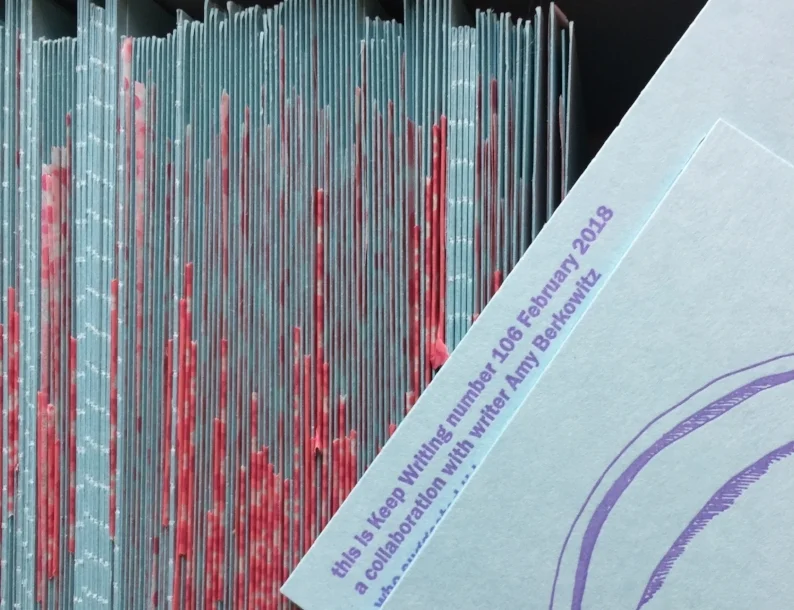
Amy Berkowitz developed the concept and wrote the text for Keep Writing number 106, in your mailbox now if you are a subscriber. (if you are missing out, subscribe here) . You can find links to some of her writing and more information about Tender Points at amyberko.com.
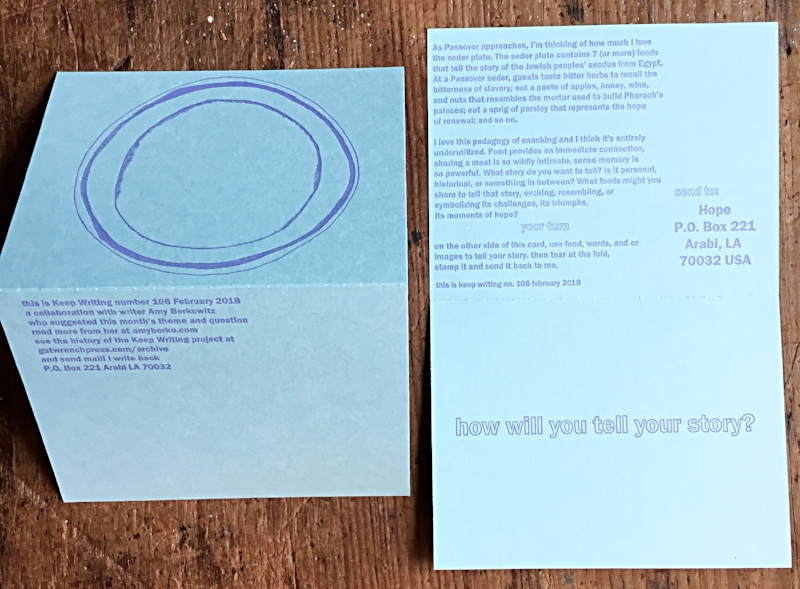
Keep Writing number 106 sent February 2018. words and concept by Amy Berkowitz. Plate illustration and design by Hope Amico/gutwrench press